Event Planning · 6 min read
Decoding Event Audio Specifications: PA Systems for Planners
An accessible guide to professional PA systems for event planners. Understand FOH, monitors, subwoofers, and how audio scalability impacts your budget.
The short version
A professional event PA system relies on a matched signal chain of FOH speakers, subwoofers, monitors, and mixing consoles. Understanding how these components scale with venue size and guest counts prevents poor coverage and protects your production budget from unexpected equipment and labor fees.
Short answer: A professional event PA system consists of Front of House (FOH) speakers for the audience, stage monitors for the performers, subwoofers for low-end bass, a mixing console, and system processing. Scalability directly impacts sound quality and cost, as larger venues require line-array systems, complex rigging, and specialized labor instead of simple point-source setups.
The Anatomy of a Professional PA System
Every professional public address (PA) system has one main job. It must take an audio source and make it clear, balanced, and loud enough for everyone in the room. To do this, the system uses several distinct components working together.
Front of House (FOH) Speakers
These are the main speakers facing the audience. They provide the primary sound coverage for your guests. In smaller rooms, these might be single cabinets mounted on tripods. In larger venues, they are typically hung in vertical columns called line arrays.
Subwoofers
Standard FOH speakers cannot reproduce deep low-frequency sounds. Subwoofers handle the bass frequencies. They provide the physical weight and impact of the sound. For events with live bands, DJs, or high-energy presentations, subwoofers are essential. Managing these frequencies is highly technical. For example, using cardioid subwoofer arrays helps control bass spill on stage while keeping the energy focused on the dance floor.
Stage Monitors
Performers cannot hear what the audience hears because FOH speakers point away from the stage. Stage monitors, also known as wedges, point back at the performers so they can hear themselves and stay in time. Some performers prefer in-ear monitors (IEMs), which offer custom mixes directly into wireless earpieces.
Mixing Console
Often called the soundboard, the console is the central control unit. Every microphone, instrument, and playback device plugs into the console. The audio engineer uses it to balance volume levels, adjust equalization (EQ), and route the signals to the correct speakers.
System Processing and Amplification
Before the audio signal reaches the speakers, it passes through processors that manage crossovers, delay times, and system limits to prevent damage. Amplifiers then boost the processed signal to drive the physical speakers. Many modern PA systems use active speakers, which have the amplifiers and processors built directly into the wooden cabinets.
How System Scalability Impacts Sound Quality and Budget
As your guest count and venue size increase, the audio system must scale to maintain sound quality. This transition is where planners often run into unexpected costs.
Point-Source Systems vs. Line Arrays
For small corporate meetings, intimate galleries, or wedding receptions under 150 guests, a point-source system is standard. These are individual speaker boxes that project sound outward in a wide cone. They are cost-effective, easy to set up, and require minimal labor.
For large ballrooms, outdoor festivals, or crowds exceeding 500 people, point-source systems fail. Sound drops off quickly over distance. To fix this, planners must scale up to line-array systems. Line arrays use multiple speaker modules hung in a precise vertical curve. This design shoots sound waves over long distances with minimal volume loss, ensuring the guest in the back row hears the same level and clarity as the guest in the front row.
The Real Drivers of Audio Cost
When scaling up a system, the equipment cost is only part of the equation. You must also budget for:
- Rigging and Safety: Hanging heavy line arrays requires certified rigging points, motors, and structural engineering approvals.
- Labor: A point-source system can be set up by a single technician in an hour. A flown line-array system requires a system engineer, riggers, and a dedicated stagehand crew.
- Power Requirements: Large systems draw significant electrical currents. You may need to budget for dedicated power drops from the venue or external generator rental.
The Core Components of Your Audio Signal Chain
Understanding how sound travels from the performer to the listener helps you troubleshoot issues during soundcheck. Here is a typical signal chain for a live hybrid performance:
- The Source: This is the microphone, acoustic guitar, or DJ deck. For instance, when I connect my gear, I must connect the DJ controller to the venue PA using balanced lines to prevent interference.
- The Stage Box: Input cables run from the stage into a digital stage box, which converts the analog signals to digital data.
- The Snake: A single digital network cable runs this data from the stage to the mixing console at the back of the room.
- The Console (FOH): The audio engineer adjusts the mix, adding effects and balancing the live instruments with the electronic tracks.
- The System Processor: The mixed stereo track is split into specific frequency bands (highs, mids, lows) and sent to the correct amplifiers.
- The Speakers: The electrical signals drive the FOH line arrays and subwoofers, delivering clear sound to the audience.
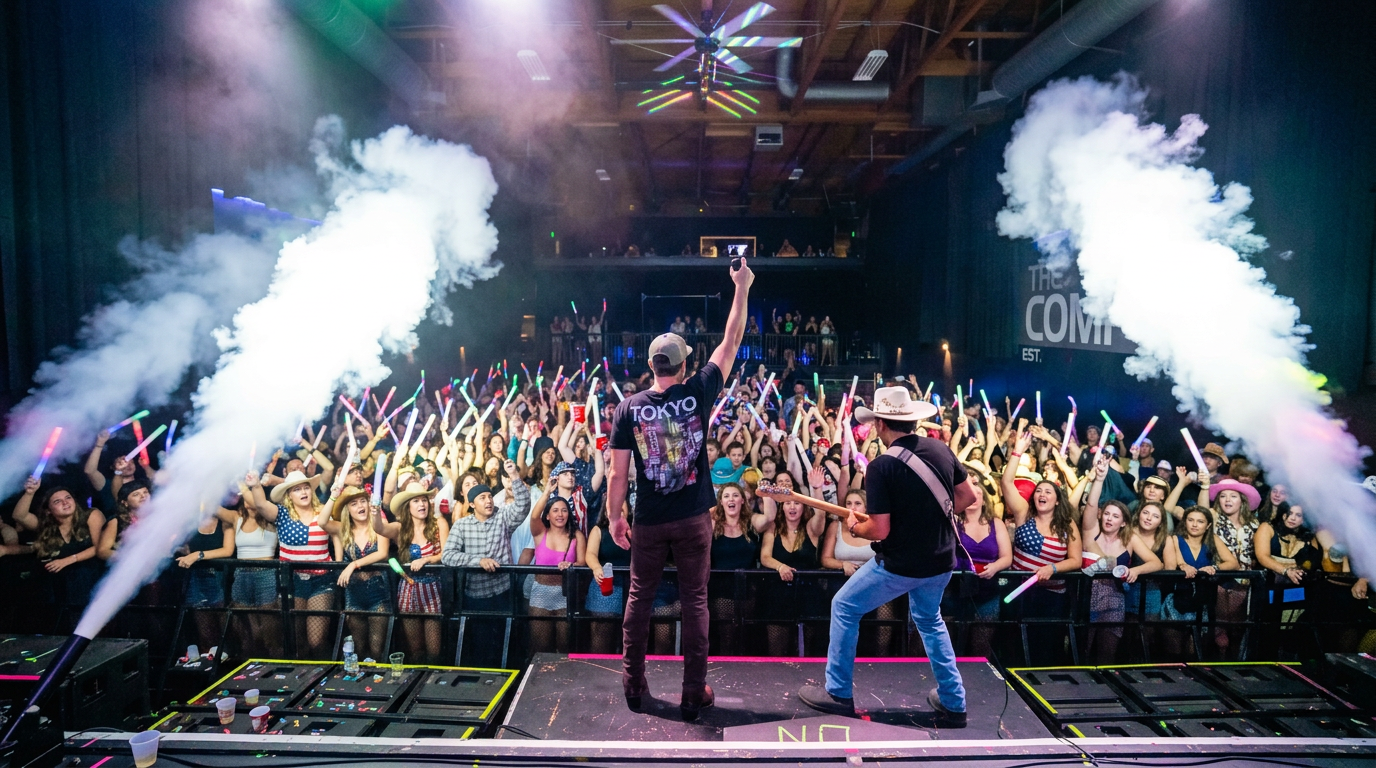
When I perform solo or with Kristian Cruz in our Mixmode project, we rely on the venue's front-of-house (FOH) setup to deliver our hybrid country EDM sound. Any break in this signal chain can cause audio drops or unwanted noise.
Practical Tips for Communicating with Audio Engineers
Planners do not need to be audio experts, but speaking the same language as your AV provider prevents costly mistakes. Here is how to advance your audio needs effectively.
Provide an Accurate Input List and Stage Plot
Do not just tell the provider you have a DJ and a guitarist. Send them a precise layout showing where the artists will stand, where power is needed, and how many inputs are required. For our Boots N' Beats 2025 Tour, we provide a detailed technical rider to ensure the local PA system matches our performance requirements. Reviewing the technical rider requirements with your artist ahead of time ensures there are no surprises on show day.
Run a Formal Technical Advance Call
Weeks before the doors open, schedule a technical call with the venue manager, the AV provider, and the artist's production team. This is the time to confirm load-in schedules, power availability, and sound limits. Knowing how to run a technical advance call ensures all technical details are resolved before gear arrives at the venue.
Essential Questions to Ask Your Audio Provider
To ensure you are getting the right system for your budget and venue, ask your AV partner these questions before signing the contract:
- Is the PA system active or passive? Active systems have built-in amplifiers, reducing the footprint and setup time. Passive systems require external amp racks and more cabling.
- Does the quote include dedicated power distribution? Larger systems cannot run on standard wall outlets. Ensure the provider is bringing the necessary power boxes and cabling.
- How will the subwoofers be configured? If your venue has strict volume limits or neighboring businesses, ask if a cardioid subwoofer array can keep the bass from bleeding into areas where it is not wanted.
- What is the backup plan for critical components? Ask if they carry spare microphones, DI boxes, and console power supplies. A single point of failure should not silence your event.
For your next event, let Jordan Miller and the production team handle the technical details to deliver pristine, high-impact sound. To discuss custom AV setups and live performance integration, visit our production booking page.
Keep reading
- Event PlanningEvent Day Schedule Management: Load-In to Last Call GuideLearn how to build a foolproof music entertainment schedule from load-in to last call. Ensure smooth setups, perfect soundchecks, and zero timeline delays.
- Event PlanningProfessional DJ Value: Beyond Playlists to Live ExperiencesLearn what a professional DJ actually does beyond playing music, including sound engineering, timeline management, and real-time crowd reading.
- Event PlanningHow to Fix Ground Loop Buzz in Venue PA Systems: Audio Hum GuideStop the 60Hz hum before it ruins your event. Learn how to diagnose, isolate, and eliminate ground loops in venue sound systems with this step-by-step technical guide.