Corporate & Venue · 4 min read
Technical Production Guide: How to Advise a Country EDM Rider
From routing wireless guitars to syncing DJ decks, here is how festival production managers and venue TDs can flawlessly execute the hybrid tech requirements of modern country touring acts
Published July 27, 2026
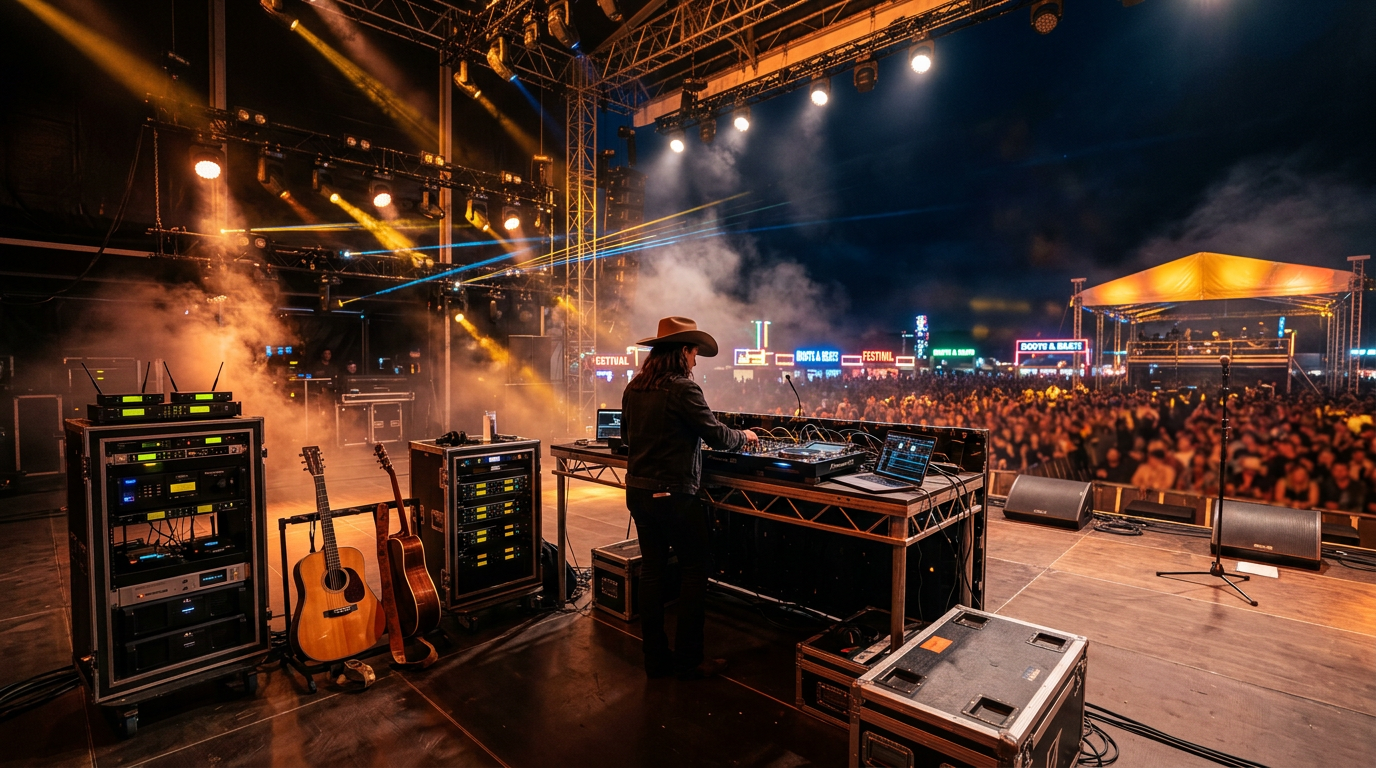
Booking a standard electronic producer is relatively simple. They require a pair of industry standard Pioneer CDJs, a compatible mixer, a robust subwoofer package, and some localized booth monitors. Booking a traditional country band is equally familiar, requiring a series of direct input boxes, wireless instrument systems, drum mics, and vocal lines.
However, the sudden rise of country EDM as a dominant force at major events, corporate gatherings, and festivals has introduced a unique challenge for stage managers and audio engineers. This hybrid genre merges the massive, sub-heavy low end of modern club music with the organic, mid-range dynamic transients of acoustic guitars, electric guitars, and live fiddles.
When these two worlds collide on stage, your technical crew cannot rely on a standard DJ rider. To ensure a seamless performance, your production team needs to understand the exact technical demands of a high-level country EDM live show.
1. The Input List: Integrating CDJs with Live Instruments
A standard DJ set uses two to four channels on a mixer, usually routed directly to the front-of-house console via a left-right main output. A hybrid country EDM show requires a dedicated input list that splits the digital playback from the live performance elements.
For a professional performance, expect the input routing to look like this:
- Channels 1-2 (DJ Deck Playback): Left and right master outputs from the DJ mixer (typically backlined Pioneer DJM-A9 or Pioneer DJM-V10) running directly into the FOH console.
- Channels 3-4 (Stems/Playback): If the act uses an external audio interface for backing tracks or MIDI-synced stems, these run as separate balanced lines.
- Channel 5 (Acoustic Guitar/Fiddle): Routed through a high-quality active Direct Input (DI) box, such as a Radial J48, to preserve the natural high-frequency response of acoustic strings.
- Channel 6 (Electric Guitar): Usually routed via a wireless system (such as a Shure Axient Digital or Sennheiser EW-DX system) into a modeler like a Line 6 Helix, Quad Cortex, or direkt to an amp isolated offstage.
- Channels 7-8 (Vocal Mics): High-rejection wireless handhelds (typically Shure SM58 or Beta 58 capsules) with dedicated channels for the DJ and any guest vocalists.
By keeping the live instruments entirely separate from the main DJ mix, your FOH engineer has the necessary control to balance the mix for the specific acoustics of your venue.
2. Managing the Frequency Clash: Bass vs. Twang
The biggest challenge for live sound engineers mixing this genre is managing space in the frequency spectrum. EDM relies on a powerful digital sub-bass, which typically thrives between 30 Hz and 90 Hz. Acoustic guitars and fiddles carry their resonance in the low-mid range, from 150 Hz to 400 Hz, with crucial high-mid clarity around 2 kHz to 5 kHz.
If the live audio engineer does not actively separate these zones, the acoustic instruments will sound muddy, or worse, get completely drowned out by the synthesized low-end.
Your utility tech should ensure that a tight high-pass filter is applied to all acoustic instruments, cutting everything below 100 Hz to prevent low-end rumble from the main PA from bleeding back into the instrument microphones. Additionally, using sidechain compression can help. By ducking the low-mids of the DJ playback by just 2 to 3 decibels whenever the live guitar or fiddle is actively playing, the melodic elements can cut through the mix without losing the energy of the dance beat.
3. Monitor Mixing and Stage Latency
Traditional DJs are accustomed to loud, localized booth monitors. Live musicians, however, require precise in-ear monitors (IEMs) to maintain their pitch and timing, especially when playing alongside fast, digital percussion.
For a touring country EDM act, a shared monitoring setup is essential:
- In-Ear Monitors (IEMs): The live instrumentalists must be on stereo IEM systems (such as Shure PSM 1000). Their mix will prioritize the click track, back-beat cues, and their own instrument levels.
- Booth Monitors: The DJ still requires high-output booth wedges (such as d&b audiotechnik M4s or L-Acoustics 112Ps) but these must be positioned carefully to avoid spilling into the live vocal or acoustic instrument microphones.
- Latency Sync: When digital wireless systems are combined with digital mixing consoles, a minor audio delay can occur. Ensure your digital console operates at 96 kHz to keep systemic latency below 2 milliseconds, keeping the live musicians perfectly in sync with the DJ decks.
4. Visual Integration: Timecode and Lighting
What makes a country EDM set truly massive is the visual sync. The energy drops of electronic music require synchronized lighting, laser, and video cues, while the organic country transitions call for warm, ambient stage washes.
To bridge this gap, ensure your lighting director (LD) and video operator can accept SMPTE timecode or MIDI cues directly from the performer's playback system. Many hybrid acts use software like ShowKontrol or ProPresenter to link their Pioneer decks directly to the grandMA lighting console. This allows the laser drops and custom rural-themed video walls to fire in perfect synchronization with the audio, creating a highly polished stadium-level experience.
When we tour with our premium live format, Mixmode, we bring a dedicated technical setup that addresses these exact routing, monitoring, and visual requirements, ensuring your local crew has an easy, stress-free load-in and soundcheck.
Book Jordan Miller
Planning a festival, corporate event, or high-profile private party that needs the energy of a country EDM show? Contact our production and booking team on our booking page to secure Jordan Miller or the live guitar duo Mixmode for your upcoming 2026/2027 calendar dates.